
Life is too short was my cliché of the day. Yesterday, I had rushed to help someone with email invitations in the morning and made an error on my computer, which was quickly pointed out. None of us are perfect. Isn’t there another cliché about good intentions?
The sun shone and I had an invitation to a talk at Clerkenwell Design Week. Life outside seemed more important than virtual office etiquette. So, I left my desk.
I am very glad I did. Matthew Hicks and Bertie Wildman of Humanscale, who had encouraged me to attend a series of talks they were hosting in office showrooms this week. Jo Ruxton was speaking of her natural history filming work for the BBC. The plastic pollution she found was something that made her raise funds for her own film and a campaign – Plastic Oceans – www.plasticoceans.uk.
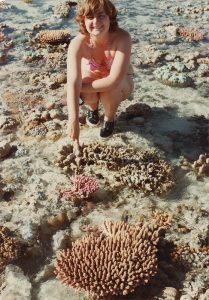
On Great Barrier Reef 1979
I knew of some her case studies from final year students’ design ethics essays and final major projects and of course from the BBC’s documentaries like Blue Planet. I was staggered by the increasing level of plastic pollution she described. I’m an amateur – a snorkeler, body surfer and beachcomber. I tell my daughter I am still eight. Then, I used to live in Puerto Rico with a beach as part of my playground. As a teenager I lived in Mogadishu and wrote poems about the glories of the marine life I found in the hollows on sandbanks. In 1979 I flew to the Great Barrier Reef in a 6-seater plane and landed in a lagoon – an astonishing heavenly world – the most valuable £50 I’ve ever spent. Yes, there was plastic discarded then. The beaches were not pristine.
I still have a collection of swizzle sticks picked up on a Hilton Hotel beach I had access to in San Juan. Plastics are so easily discarded. I also remember glass amongst the shells but always smoothed by the sea. We seem so relaxed about litter and waste. People say, “it is someone else’s problem to sort out”. Or that “it provides work for street sweepers and rubbish pickers” – the poorest and most disadvantaged groups worldwide. “It will rot down.” We’re simply lazy and unthinking and it is costing us the planet.
What was great about Jo Ruxton’s work? She is keen to do the science to back up what she has found in her film work. She is positive about what we can all do, by simply changing what we do – in particular – to stop using single use plastics. Many of the things we do use are about convenience. We want a quick and easy solution now to our personal need. We simply do not think or know of the consequences. The leaflet she handed out after the show has a list simple actions that we can all make. She encouraged more research into finding ways of reversing our global habit of using the sea as waste bin. Plastics, like weeds, are valuable in the right place.
Yes, she inspired me and left me mumbling “life is too short” – not to try to do something. I will see if I can ask her to come and speak at the University of Northampton. In product design education and waste management research, we can make an impact beyond the walls of the institution. If you get a chance hear her talk or watch the Plastic Ocean film, then do so. Thanks must go to a product designer’s critique online that made me leave my desk, to the office furniture designers, who invited me to hear her speak and to the hot desking company (Work.life) that gave me a cotton bag blazoned with, ”because life is too short” tens minute later. Very apt.
Copyright Vicki Thomas 2019